
How the Global Polycrisis Caused a Regional War
The Interlocking Doom Loops that Ignited the Iran Conflict

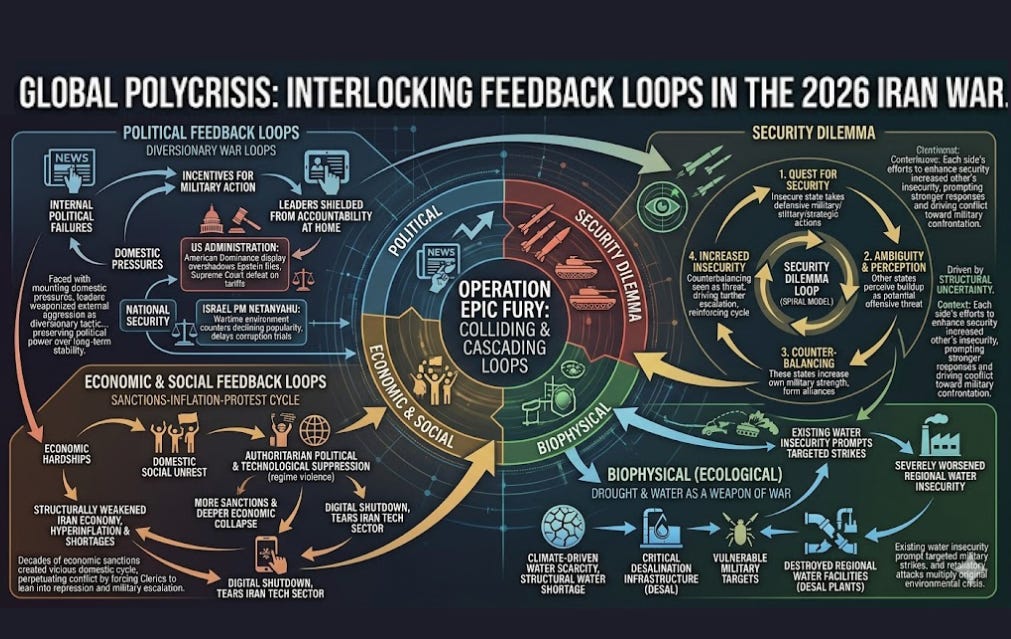
The 2026 war in Iran is far more than an isolated geopolitical flashpoint; it is a textbook manifestation of a global polycrisis driven by reinforcing feedback loops. Viewed through a systems thinking lens, modern global systems are bound together in an interconnected web of emergencies where the output of one failure continuously recirculates as the volatile input of another.
Long before kinetic operations commenced, a network of cross-domain “doom loops” silently locked the United States, Israel, and Iran into an escalatory slipstream. While a classic security dilemma primed the military systems for confrontation, the true catalyst for war was a multifaceted web of overlapping stress factors. These self-reinforcing cycles spanned interlocking domains to collectively drive the descent into global warfare.
The Security Dilemma Loop
One of the most obvious feedback cycles is the security dilemma loop (aka the spiral model). This is a concept where actions taken by a state to increase security threaten other states. This triggers reciprocal reactions, ultimately decreasing the security of everyone involved.
The mechanics of the loop are driven by structural uncertainty and are broken down into four continuous phases:
1. The Quest for Security: An insecure state takes defensive military or strategic actions to protect itself.
2. Ambiguity & Perception: Other states perceive the buildup as a potential offensive threat.
3. Counter-Balancing: These other states increase their own military strength and/or form defensive alliances.
4. Increased Insecurity. The counterbalancing is seen as a threat, driving further escalation and reinforcing the cycle.
In the context of the war in Iran, each side’s actions, intended to increase security, are interpreted by the other as threatening, and this provokes countermeasures.
1. Iran steadily advanced its nuclear enrichment and ballistic missile programs.
2. The United States and Israel perceived this as a threat to regional stability leading the U.S. to initiate its largest military buildup in the Middle East since 2003.
3. Rather than deterring Tehran, this massive accumulation of military hardware signaled a clear offensive intent. Iran reacted by hardening its defensive postures, underground installations, and amplifying proxy activities.
4. These Iranian responses reinforced U.S. and Israeli perceptions that Iran is dangerous leading them to launch what they described as necessary pre-emptive strikes.
In short, each side’s efforts to enhance security increased the other’s sense of insecurity, prompting stronger responses that amplified tensions and drove the conflict toward military confrontation.
Political Feedback Loops: Diversionary War Loops
The diversionary war loop is perhaps the most cynical feedback mechanism driving the crisis. Internal political failures created incentives for military action, while the resulting conflict shielded leaders from accountability at home. Faced with mounting domestic pressures, leaders in Washington and Jerusalem found significant political utility in a high-stakes foreign confrontation. Military escalation allowed them to dominate the news cycle under the banner of national security, redirecting public attention away from domestic controversies and reinforcing the political benefits of maintaining a permanent state of crisis.
For the Trump administration, the strikes provided a dramatic display of “American dominance” that overshadowed scrutiny surrounding the Epstein files and a damaging Supreme Court defeat on tariff policies. At the same time, Israeli Prime Minister Benjamin Netanyahu used the wartime environment to counter declining popularity and further delay his ongoing corruption trials. In both cases, the preservation of political power took precedence over long-term strategic stability. The conflict itself became a political asset, creating a self-reinforcing cycle in which domestic vulnerability encouraged external aggression, and this contained the political damage of domestic failure.
Economic and Social Feedback Loops: Sanctions-Inflation-Protest
While the spiral model and diversionary war are salient factors, the feedback loops contributing to the conflict in Iran cannot be reduced to any single catalyst. The war is the explosive result of a multifaceted, compounding network of overlapping, self-reinforcing stress factors. It was triggered by interlocking feedback loops across the five systems that define polycrisis: political, economic, social, technological, and biophysical.
The sanctions-inflation-protest cycle is an example of a feedback loop that cascades across domains. Sanctions caused economic hardships, leading to domestic social unrest, which drove authoritarian political and technological suppression, ultimately reinforcing and worsening the economic crisis.
Decades of economic sanctions structurally weakened Iran’s economy and unleashed a combination of hyperinflation and severe shortages. In early 2026, economic suffering pushed the civilian population to take to the streets in historic civil protests. To suppress internal dissent, the regime responded with a violent crackdown and an internet blackout. This triggered more sanctions and a deeper economic collapse. The situation was compounded by the digital shutdown, which devastated Iran’s domestic tech sector and non-oil economy. The factors perpetuating a vicious domestic economic cycle also perpetuated the conflict by forcing the Clerics to lean even harder into repression and military escalation.
Ecological Feedback Loops: Drought and Water as a Weapon of War
Drought is a threat multiplier, turning environmental vulnerabilities into inviting military targets. This is a self-reinforcing feedback loop in which regional water scarcity transforms critical desalination infrastructure (desal) into highly vulnerable military targets, where the resulting warfare directly multiplies the original environmental crisis. Existing water insecurity prompts targeted military strikes on desalination plants and retaliatory attacks that destroy additional regional water facilities.
The Middle East has long suffered from structural water scarcity and climate-driven droughts, making Gulf nations almost entirely dependent on desalination. This vulnerability prompted strikes against the desalting facility on Qeshm Island, and water desal plants in Bahrain, Kuwait, and the UAE. The targeted destruction of desal infrastructure directly feeds back into the cycle, severely worsening regional water insecurity.
Conclusion: How Interlocking Loops Drove the Descent to War
The outbreak of the 2026 war in Iran is a case study in how modern conflicts are the byproduct of compounding feedback loops. When viewed through a systems thinking lens, the descent into Operation Epic Fury reveals a pattern of inputs that amplified systemic instability. The path to war was paved across multiple domains simultaneously. Geopolitically, the classic security dilemma trapped the U.S., Israel, and Iran in a spiral of reciprocal military build-ups, which ultimately validated the logic of pre-emptive strikes. This military tension was reinforced by cynical political feedback loops, where embattled leaders in Washington and Jerusalem weaponized external aggression as a diversionary tactic to bury domestic scandals and delay legal accountability, cementing a war footing for personal survival.
The war in Iran both exacerbated the polycrisis and was triggered by it. Simultaneously, economic, social, technological, and environmental loops acted as internal engines driving the parties to war. Western sanctions contributed to economic hardship, which fueled protests; the regime’s crackdown prompted additional sanctions, creating a vicious feedback loop. This loop was supercharged by climate-driven water scarcity, which turned critical desalination infrastructure into inviting military targets. These diverse feedback loops collided, cascaded, and fed into each other, creating a self-perpetuating slipstream that dragged the region into war.